
Big data analytics dashboard with financial statistics representing Sage Intacct accounting software and real-time insights

What Makes Sage Intacct Different from Traditional Accounting Software?

Big data analytics dashboard with financial statistics representing Sage Intacct accounting software and real-time insights

The best accounting software does more than capture figures – it supports how your business operates today and helps guide where it’s going next.

Many organisations begin with a straightforward system supported by spreadsheets. It works for a time… until it doesn’t. As operations expand, that patchwork approach can quickly become a constraint, reducing visibility and slowing down decision-making.

The real distinction between entry-level tools and a modern financial platform isn’t just functionality. It’s about having access to accurate, real-time data that enables confident, strategic decisions – not simply keeping pace with transactions.

Why the right choice matters

Most finance teams start out using basic accounting tools, often alongside spreadsheets. In the early stages, this setup can be effective, especially when transaction volumes are low and reporting requirements are relatively simple.

However, as a business grows – adding new entities, locations, or revenue streams – limitations begin to surface.

We regularly speak with finance leaders who spend significant time on manual reconciliations, offline reporting, and workarounds just to gain clarity at month-end. While this approach may keep things moving, it leaves little room for forecasting, analysis, and planning – the activities that truly support growth.

What is traditional accounting software?

Traditional accounting software typically refers to on-premise systems, desktop applications, or basic cloud tools designed primarily for bookkeeping.

These solutions generally focus on core functions such as:

  • Accounts payable and receivable
  • Bank reconciliation
  • VAT processing

While they help maintain financial records, they often rely heavily on manual input and spreadsheets for reporting.

They can also fall short when it comes to:

  • Managing multiple entities or currencies
  • Supporting project-based accounting
  • Providing real-time visibility

In essence, they record financial activity – but don’t always deliver the flexibility or insight required by modern finance teams.

What is Sage Intacct?

Sage Intacct is a cloud-native financial management solution designed for growing organisations that need more than basic accounting functionality.

It combines automation, adaptability, and real-time reporting to give finance teams greater control and visibility across the business. Key features include:

  • A multi-dimensional general ledger that enables deeper analysis without complex account structures
  • Real-time dashboards and custom reporting tailored to different roles
  • Automation of processes such as approvals and reconciliations
  • Secure cloud access for teams working across multiple locations

As a Sage Intacct partner, Envisage works closely with organisations to configure the platform around their processes – rather than forcing them to adapt to the system.

A new layer: AI-powered financial management

One of the most significant developments in modern finance technology is the rise of AI – and this is where Sage Intacct stands apart.

Sage Intacct AI is purpose-built for finance teams, helping to reduce manual effort, improve accuracy, and uncover deeper insights.

Powered by Sage Ai and Sage Copilot, it can:

  • Reduce manual data entry by up to 90%
  • Speed up the month-end close process
  • Highlight anomalies and potential errors early
  • Deliver predictive insights based on real financial data

With Sage Copilot, users can interact with financial data using natural language – asking questions, identifying trends, and taking action more efficiently.

Rather than replacing finance professionals, these capabilities enhance their role, allowing more time to focus on analysis and strategic decision-making.

How Sage Intacct differs from traditional systems

Smarter general ledger

Traditional systems often require new account codes for every reporting variation, which can quickly become complex and difficult to manage.

Sage Intacct takes a more flexible approach with its multi-dimensional ledger:

  • Transactions can be tagged by department, project, location, or customer
  • Reports can be generated instantly without relying on spreadsheets

The outcome is simple: less time searching for information, and more time putting it to use.

Cloud-native by design

Unlike systems that have been retrofitted for the cloud, Sage Intacct is built specifically for a cloud environment.

This provides:

  • Real-time access to the same data across all users
  • Elimination of version control issues from spreadsheets
  • Automatic updates, including new AI-driven features
  • Seamless integration with other business systems

For growing or geographically dispersed teams, this level of flexibility is essential.

Built-in automation

Manual processes remain one of the biggest challenges for finance teams.

Sage Intacct addresses this through:

  • Configurable approval workflows
  • Automated intercompany transactions and consolidations
  • AI-powered tools that reduce repetitive tasks

Even incremental efficiencies can result in meaningful time savings – freeing up capacity for more valuable work.

Real-time reporting

With traditional tools, reporting often involves exporting data, reworking it in spreadsheets, and distributing static reports.

Sage Intacct transforms this approach:

  • Role-based dashboards provide real-time visibility of key metrics
  • Reports are interactive, with drill-down capabilities
  • Stakeholders can access insights directly, without relying on finance teams

This shifts the focus from validating numbers to making informed decisions.

Why Sage Intacct works for growing businesses

For organisations that have outgrown entry-level systems, Sage Intacct provides the control and scalability needed to support continued growth.

It is particularly well suited to businesses that require:

  • Multi-entity and multi-currency capabilities
  • Strong financial controls combined with flexibility
  • Industry-specific functionality
  • A platform that scales without increasing complexity

Importantly, implementation can be phased – allowing organisations to start with core finance and expand over time.

Why work with a Sage Intacct partner?

Selecting the right software is only one part of the process. How it is implemented and supported plays a critical role in long-term success.

At Envisage, we specialise in Sage Intacct implementation, development, and ongoing support for growing organisations. Our focus is on helping you realise tangible value from the platform – not simply getting it up and running.

If you are considering a move away from traditional accounting systems, we can help assess whether Sage Intacct is the right fit and design an approach tailored to your business.

Ready to see what’s possible?

If your current system is limiting your progress, it may be time to rethink how your finance function operates.

With Sage Intacct and its AI-powered capabilities, you can reduce manual workloads, gain real-time visibility, and make faster, more informed decisions.

Get in touch with our team to explore how Sage Intacct can support your next stage of growth – or book a demo to see it in action.

About the Author

Picture of Steve Boyes

Steve Boyes

Steve Boyes, the COO at Envisage, brings over 20 years of experience in accounting and IT to the table. With a robust background in specifying, designing, implementing, and supporting strategic solutions for SMEs, public sector, and not-for-profit organisations, Steve excels in addressing clients' real business problems and requirements rather than just focusing on technology. His approach has led to the successful execution of projects with some of Ireland's best-known companies.


Sage accounting software for charities and non-profits

Cloud Accounting Software for Charities: The Ultimate Guide for Non-profit Finance Teams

Sage accounting software for charities and non-profits

Month-end deadlines, grant reports, funder updates, audit queries – for many non-profit finance teams, the workload never really slows down. You may begin the week planning to focus on forecasting or strategic planning, only to find yourself chasing missing paperwork, updating spreadsheets, or responding to last-minute board requests.

Cloud charity accounting software has become essential for organisations that need to stay compliant, remain transparent, and give leadership teams reliable financial insight. This guide explores why more non-profits are moving away from disconnected systems and manual processes – and how solutions like Sage Intacct are helping finance teams move from reactive reporting to proactive financial management.

Why automation and visibility matter for non-profit finance teams

Non-profit organisations operate in a uniquely demanding environment. Finance teams are often small, yet responsible for managing multiple income streams, restricted funding, programme reporting, and regulatory compliance. At the same time, trustees and senior leaders expect real-time visibility and forward-looking insight.

Traditional accounting systems and spreadsheets were not designed for this level of complexity. When financial data is scattered across separate tools, consolidation becomes manual and time-consuming. Tracking restricted and unrestricted funds requires workarounds. Producing tailored reports for different stakeholders often means rebuilding spreadsheets from scratch.

Cloud charity accounting software changes that dynamic. Instead of adding more manual steps, it centralises data, automates processes, and provides structured workflows that scale as your organisation grows.

See the full financial picture in one place

One of the most significant challenges non-profit finance teams face is limited visibility. When information lives in multiple spreadsheets or disconnected systems, gaining a clear view of financial health becomes difficult.

Modern charity accounting software provides a single source of truth. Core capabilities typically include:

Funding and grant accounting, allowing you to track restricted and unrestricted income separately and allocate costs accurately

Multi-entity and multi-location support, enabling consolidated reporting while still analysing performance by project or programme

Dimensional reporting, giving you flexibility to analyse data by funder, initiative, department, or location

With this level of transparency, finance leaders can answer trustee questions quickly and confidently. Instead of reconciling figures from different sources, reports reflect real-time data drawn from a connected system.

Reduce manual work and repetitive processes

Non-profit finance teams frequently lose hours to repetitive tasks – re-keying data, reconciling spreadsheets, and manually allocating transactions. These tasks not only consume time but also increase the risk of errors.

Cloud-based accounting software helps automate routine processes, including:

Automated bank reconciliations

Recurring journals for accruals and prepayments

Integration with fundraising, CRM, and donor management systems

Automated approval workflows

By reducing manual data entry, teams can shift their focus toward analysis, forecasting, and supporting strategic decisions. Automation also supports more consistent processes, which is especially valuable during busy reporting periods or year-end close.

Stay audit-ready with stronger controls

Non-profit organisations must demonstrate accountability at every stage. Auditors and regulators require clear documentation showing how funds were received, allocated, and approved.

Accounting systems supports compliance through structured controls such as:

Role-based permissions that limit access based on responsibilities

Configurable approval workflows for spending and journal entries

Detailed audit trails recording who created or amended transactions

These features reduce reliance on manual checklists and email chains. Instead, controls are embedded directly within the system. Finance teams can respond to audit queries quickly, with clear documentation available at the click of a button.

Deliver tailored reporting for boards and funders

Boards, grant providers, and regulators expect clear, timely reporting – often in different formats. Producing these reports manually can be one of the most time-consuming parts of a finance team’s workload.

Non-profit financial management software simplifies reporting through:

Real-time dashboards displaying cash position, funding streams, and programme performance

Flexible report templates that can be adapted for different stakeholders

Drill-down capabilities that allow users to trace summary figures back to individual transactions

Instead of static spreadsheets, finance leaders gain dynamic reporting tools that support trust and transparency. Data becomes easier to interpret and share, strengthening decision-making across the organisation.

Plan ahead with forecasting and scenario modelling

Managing today’s numbers is only part of the job. Non-profit organisations must also prepare for funding fluctuations, cost changes, and evolving programme demands.

Modern cloud systems support forward-looking financial management by enabling teams to:

Build rolling forecasts that update continuously

Model funding and cost scenarios to assess impact on reserves and cash flow

Share up-to-date insights quickly with trustees and leadership teams

Forecasting becomes an ongoing process rather than a once-a-year exercise. This helps organisations remain resilient and prepared, even in uncertain funding environments.

Support hybrid and remote teams

Ways of working have evolved. Many non-profit finance teams now operate in hybrid or fully remote environments. On-premise systems and paper-based processes can create bottlenecks when staff are not physically present in the office.

Cloud charity accounting software is accessible securely from anywhere. This allows:

Month-end and year-end processes to continue without disruption

Approvals to happen digitally rather than through manual sign-offs

Easier onboarding of new staff and volunteers

Accessibility enhances resilience. Teams can maintain continuity regardless of location, ensuring financial management remains consistent and controlled.

Key benefits of cloud charity accounting software

To summarise, the move to cloud-based systems offers non-profit finance teams:

Centralised financial visibility

Reduced manual data entry

Stronger compliance controls

Faster, tailored reporting

Improved forecasting capabilities

Greater flexibility for hybrid teams

These benefits collectively reduce operational stress and allow finance professionals to focus on supporting their organisation’s mission.

Turning insight into action

If your finance team is still relying heavily on spreadsheets or disconnected tools, it may be time to reassess whether your current system supports your organisation’s needs.

Modern non-profit finance is no longer just about staying compliant. It’s about providing clarity, insight, and confidence to leaders, trustees, and funders.

If you’re ready to explore how cloud charity accounting software could support your team, download our guide to learn how you can move from reactive reporting to proactive financial management – and from surviving to thriving.

About the Author

Picture of Kyle Moore

Kyle Moore

Kyle works as a Senior Consultant on the implementation team for Envisage. His focus is on the Sage 200 accounting system products and some of the value-added products. Kyle started off at Envisage on the technical support side before he moved over to the implementation team. With 25 years of experience working with Sage 200 in its various guises, he has vast knowledge of the product and our customers, and understands how their businesses work.

Abstract office interior with digital world map representing international business growth supported by Sage Intacct

Planning for International Growth? How Sage Intacct Supports Expanding Businesses

Abstract office interior with digital world map representing international business growth supported by Sage Intacct

Entering new markets is a major step for any organisation. It creates opportunities for additional revenue, access to wider customer bases, and a stronger long-term position. However, international growth also brings added complexity for finance and operations teams, who must maintain oversight while business structures, regulatory obligations, and reporting needs become more demanding.

As new entities are created and additional currencies and compliance rules come into scope, spreadsheets and older finance systems can quickly become a limiting factor. Manual processes increase the likelihood of error, slow down reporting, and make it more difficult to gain a consistent view of performance across regions. For many Irish organisations, this is where a modern, cloud-based financial platform becomes essential. Sage Intacct delivers the structure, automation, and insight needed to support overseas expansion without introducing unnecessary complexity.

Why Irish organisations are expanding internationally

For many businesses headquartered in Ireland, expanding internationally is a natural progression once local markets become saturated or growth begins to level off. Moving into new regions enables organisations to reach broader audiences, introduce established products or services to new markets, and develop more balanced and sustainable income streams.

Expanding across Europe and beyond also helps reduce dependence on any single economy. A more geographically diverse operation allows businesses to manage regional fluctuations and build greater resilience into their business model. From the perspective of investors and stakeholders, operating in multiple markets often reflects maturity and scalability, strengthening confidence in long-term strategy and future growth potential.

That said, international expansion requires more than commercial ambition. Finance teams must be able to establish new entities efficiently, manage multiple currencies, and produce accurate financial reporting at both local and group level. This calls for systems that can grow alongside the organisation, rather than becoming an obstacle as complexity increases.

The complexity of going global

Operating in another country involves far more than adjusting language or pricing. Behind the scenes, finance and operations teams must navigate a range of practical and regulatory challenges, such as:

• Multi-entity structures – Creating subsidiaries, branches, or joint ventures while ensuring they align with group accounting policies and reporting frameworks

• Multi-currency transactions – Handling transactions in local currencies, managing exchange rate revaluations, and producing consolidated reports for domestic and international stakeholders

• Regulatory and tax requirements – Meeting the demands of different tax systems, statutory reporting standards, and local compliance rules that vary from country to country

When these challenges are supported by disconnected systems or manual processes, reporting cycles become longer, visibility is reduced, and the risk of inaccuracies increases. As international operations expand, these inefficiencies can quickly restrict further growth.

The importance of real-time financial visibility

In a multi-country structure, access to timely and accurate data is critical. Finance leaders need up-to-date insight across all entities to track cash flow, margins, and operational performance, and to identify emerging risks before they become serious issues. Consistent group-wide KPIs also make it easier to compare performance between regions and identify trends, whether that highlights underperformance in one location or growth opportunities in another.

Current information is particularly important during the month-end close. Where manual consolidations and spreadsheet-driven reporting are relied upon, delays are difficult to avoid. A single, centralised finance system allows organisations to work from one reliable source of data, shortening close cycles and enabling leadership teams to make decisions based on accurate, current figures.

Sage Intacct supports this requirement through real-time dashboards, automated reporting, and flexible analysis tools, giving finance teams and executives a clear view of performance across borders.

How Sage Intacct accounting software enables international growth

Sage Intacct is designed specifically for growing, multi-entity organisations. For Irish businesses preparing for international expansion, Sage Intacct accounting software provides a strong platform for scaling operations while retaining control and consistency. Key features include:

• Multi-entity and multi-currency capabilities as standard, enabling multiple subsidiaries and locations to operate within a single system

• Automated intercompany transactions and consolidations, reducing manual processing and speeding up month-end close

• Dual-currency and multi-GAAP reporting, supporting accurate financial statements at both local and group level

 Flexible reporting structures that can be adapted to different industries, operating models, and regulatory environments

• Cloud-native delivery, eliminating the need for on-premise infrastructure and ensuring continuous updates and security enhancements

As organisations expand into new territories, Sage Intacct can be deployed to additional entities without replacing the core finance system. This allows for consistent processes across the group, while still supporting local requirements where necessary.

Control, compliance, and scalable implementation with Sage Intacct

As international operations grow, maintaining strong governance becomes increasingly important. Sage Intacct includes built-in controls that help finance teams apply consistent processes across regions while meeting local compliance requirements. These include role-based access controls, full audit trails, automated approval workflows, and centralised reporting from a single source of truth. Together, these capabilities provide visibility across entities, departments, projects, and currencies, while reducing risk and supporting faster, more confident decision-making.

At Envisage, we help organisations achieve these outcomes through a structured Sage Intacct implementation approach. This involves aligning the system with existing processes while planning for future growth. From configuring multi-entity and multi-currency functionality to supporting phased rollouts and ongoing optimisation, we ensure that Sage Intacct accounting software is not only suitable for current operations but ready to scale as new markets are added.

Supporting long-term growth with Sage Intacct

With the right Sage Intacct implementation and guidance from an experienced Sage Intacct Partner, growing organisations can establish a finance function that is ready for international operations from the outset. If you are planning to expand into new markets and want to understand how Sage Intacct accounting software can support your strategy, the team at Envisage can help you take the next step and show how a scalable financial platform can underpin your global ambitions.

Get in touch today.

About the Author

Picture of Chris Hawley

Chris Hawley

Chris is the Managing Director at The Noledge Group and brings over 34 years of experience delivering ERP solutions across industries like retail, distribution, manufacturing, and construction. During his 24 years at Sage, he worked with nearly every product and notably transformed Sage 200 as its Product Manager, turning it into a leading solution for SMEs in the UK and Ireland. Chris takes pride in the continued success of Sage 200, supported by Sage Business Partners like Envisage.

Employees reviewing business intelligence dashboards and analytics data

Key Technologies, Trends, and Choices Shaping the Future of Small Business Accounting Software

Employees reviewing business intelligence dashboards and analytics data

As 2026 approaches, small businesses are preparing for a period of rapid transformation across finance, operations, and technology. Accounting software was once used primarily for bookkeeping and compliance but has evolved into a central driver of strategic decision-making. Advances in artificial intelligence (AI), smarter automation, real-time analytics, and cloud accessibility are reshaping how small businesses manage their finances, respond to challenges, and plan for growth. 

With so many new capabilities on the horizon, selecting the right accounting system, and the right Sage partner to support implementation has never been more important. To prepare for the year ahead, small businesses must understand not only what software solutions can do today, but also how these tools will influence the way they work in the future. 

Accounting trends defining 2026 

Regulatory shifts, rising customer expectations, and more complex operating environments all influence how financial processes are managed. Staying ahead of accounting trends is now essential for remaining competitive, compliant, and resilient. 

AI-powered automation moves into the mainstream 

In 2026, AI will be a core component of the modern accounting experience. From the automation of basic tasks to the delivery of predictive insights, AI helps small businesses work more efficiently, reducing the need to take on extra finance staff. 

Automated invoice processing, categorisation, bank reconciliation, payment scheduling, and expense approvals are becoming baseline features in leading platforms. This allows teams to reallocate time toward higher-value work, such as financial planning, supplier negotiations, or evaluating growth opportunities. 

However, the shift toward AI-driven finance also requires strong oversight. Automated processes must be monitored to ensure accuracy, and businesses must be prepared to adapt workflows, audit trails, and approval processes. Upskilling staff is essential, so teams understand how to interpret AI-generated insights and confidently make data-driven decisions. 

Cloud accounting takes centre stage 

Cloud technology continues to dominate accounting software, especially as hybrid and remote work environments become the norm. Cloud-based platforms like Sage Intacct offer real-time access for employees, advisors, and leadership teams, ensuring consistent visibility across multiple locations, devices, and business units. 

The cloud also supports ongoing digital tax and regulatory changes, helping businesses stay compliant as requirements continue to evolve. Automated updates ensure that software stays compliant without manual intervention, reducing the risk of errors in tax submissions or reporting. 

But reliance on the cloud also introduces new considerations. Cybersecurity threats continue to rise, making robust data protection measures, such as strong encryption, multi-factor authentication, and strict access controls, absolutely essential. Businesses must commit to maintaining secure environments as they embrace the advantages of cloud accounting. 

Real-time data and intelligent reporting become expected 

The era of waiting for month-end figures is over. In 2026, small businesses can expect instant access to accurate, up-to-date information. 

Modern dashboards offer: 

  • Real-time cash flow monitoring 
  • Instant drill-down reporting 
  • Automated forecasting 
  • Scenario planning 
  • Alerts for unusual activity or emerging risks 

These capabilities allow businesses to be proactive rather than reactive. Yet, real-time reporting is only as strong as the data feeding it. For many SMEs, the challenge lies in ensuring consistent data quality, enforcing proper coding and categorisation, and training teams to interpret analytics effectively. 

Businesses must invest in both technology and education to take full advantage of the opportunities offered by real-time insights. 

Security and compliance become critical priorities 

As digital transformation accelerates, financial data becomes more vulnerable. Cyber criminals are targeting organisations of all sizes, and even small businesses now face sophisticated threats. This makes security one of the most important considerations in accounting software selection. 

Key features shaping secure finance systems include: 

  • Multi-factor authentication 
  • Permission-based access 
  • Built-in audit trails 
  • Continuous updates 
  • Automated compliance features 

While increased regulation, from GDPR updates to ESG reporting expectations, adds pressure, the right software drastically simplifies compliance. The key challenge for businesses is keeping pace with these changes while ensuring financial processes remain both efficient and protected. 

What to look for when choosing accounting software in 2026 

With today’s rapidly shifting landscape, small businesses should choose accounting solutions that support long-term performance, not just immediate needs. The best platforms offer: 

  • • AI and advanced automation to reduce manual workloads and provide predictive insights 
  • • Seamless integration with other core systems 
  • • Scalable cloud access so the software can grow as the business expands 
  • • Built-in compliance and strong security for peace of mind 
  • • Flexible, modular functionality that adapts as needs evolve 

The goal is to adopt a system that makes accounting easier today while supporting growth in the years ahead. 

Why Sage accounting software stands out for small businesses 

Sage remains one of the world’s most trusted accounting providers, and for good reason. In 2026, Sage Intacct will continue to lead the way with advanced financial management capabilities designed specifically for growing organisations. 

Key strengths include: 

  • AI-powered tools such as Sage Copilot, which automate routine tasks, flag upcoming deadlines, and identify opportunities to reduce costs 
  • Real-time cloud collaboration, giving finance teams and business leaders shared visibility anytime, anywhere 
  • Multi-currency capability and support for digital tax requirements, ideal for businesses expanding 
  • Flexible modules for areas like project accounting, inventory, or order management 
  • Robust data security and built-in compliance features, supported by continuous updates 
  • Strong integration capabilities that allow Sage Intacct to connect with other essential business applications 

For small businesses aiming to prepare their operations for growth, Sage provides a stable, intelligent, and scalable financial foundation.  

The critical role of a Sage Intacct partner in 2026  

Choosing the right accounting software is only the first step. Successful digital transformation requires expert guidance, tailored implementation, and ongoing support, which is where a Sage Intacct partner becomes invaluable. 

At Envisage we help businesses: 

  • Configure Sage Intacct around specific processes, not generic templates 
  • Ensure smooth data migration and system setup 
  • Provide training and user adoption support 
  • Offer ongoing guidance as the business grows or regulations evolve 
  • Maximise ROI by aligning technology with long-term objectives 

Rather than offering one-time fixes, Envisage takes a collaborative, strategic approach. This ensures your accounting software becomes an asset that drives efficiency, accuracy, and growth year after year. 

Looking ahead – the future of small business accounting 

The next few years will bring even more innovation, enhanced AI, deeper automation, smarter reporting, and new compliance standards. For small businesses, 2026 is not just about adapting to new technology; it’s about leveraging it to operate more effectively, make faster decisions, and achieve sustainable growth. 

With the right accounting software and the right Sage Intacct partner supporting your journey, your business will be better prepared for whatever the future holds. Get in touch with Envisage to explore how our Sage expertise can help your business thrive in 2026 and beyond.  

About the Author

Picture of Steve Boyes

Steve Boyes

Steve Boyes, the COO at Envisage, brings over 20 years of experience in accounting and IT to the table. With a robust background in specifying, designing, implementing, and supporting strategic solutions for SMEs, public sector, and not-for-profit organisations, Steve excels in addressing clients' real business problems and requirements rather than just focusing on technology. His approach has led to the successful execution of projects with some of Ireland's best-known companies.

A businessman in a suit analysing financial charts using Sage accounting software

The Best Accounting Software for a Growing Business: What Really Matters

A businessman in a suit analysing financial charts using Sage accounting software

As your business grows and evolves over the years, so too must your software. With growth comes complexity; more products/services, more customers, more transactions, and much more data. Yet, many businesses in Ireland still use outdated systems to handle their finances. These entry-level tools can only take you so far, and to sustain growth, you need the best accounting software. With automation, scalability and real-time insights, you can stay competitive.  

Comprehensive financial management software, like Sage 200 or Sage Intacct, can change the way your accounting teams work. By combining intelligent automation, industry-leading reporting, and seamless accessibility, these Sage accounting software solutions are far more than a basic bookkeeping tool. They become the engine that drives your business forward. 

Why smarter financial management is key for growth

Financial management can become more demanding as your business grows. Handling tasks like multi-entry reporting, currency conversions and cash flow forecasting manually can cause a whole host of problems. Outdated systems often lack integration between departments too, resulting in duplicated effort, increased risk and delays in decision-making. 

When business owners upgrade to modern accounting systems, like Sage solutions, finance teams can work smarter and faster. You will have real-time visibility across the organisation, accuracy at every level and more efficient processes; all while freeing up your accounting department to focus on strategy rather than spreadsheets. 

If your current accounting setup has its limitations, it might be time to consider a more suitable alternative. Here are some signs that your business could benefit from a Sage 50 upgrade: 

The month-end close is taking longer each time you do it 

Reporting involves manual data exports or multiple spreadsheets 

Key systems like inventory management don’t integrate with your accounts system 

The finance team spends more time reconciling figures than analysing them 

Remote access is unreliable or insecure 

If these problems sound familiar, upgrading to a cloud-based financial management software could completely change the way you operate.

How modern accounting software supports business growth

Upgrading your accounting system is a chance to reimagine how your business operates. Modern solutions like Sage 200 and Sage Intacct go beyond bookkeeping to deliver real-time insight, automation, scalability, and intelligent forecasting – all essential to driving sustainable growth. 

• Real-Time Visibility 
With built-in analytics and dashboards, decision-makers gain accurate, up-to-date insights into performance, helping them act faster and with greater confidence. 

• Automation and Efficiency 
Automated processes reduce manual work and minimise errors, allowing finance teams to spend more time on strategy and growth initiatives. 

• Scalability and Flexibility 
Cloud-based Sage systems adapt as your business evolves, supporting new locations, users, or products – while enabling secure, remote collaboration from anywhere. 

• Intelligence and Foresight 
AI-powered tools, such as Sage Copilot, deliver predictive insights on cash flow and highlight anomalies before they become problems, helping you stay one step ahead. 

Businesses with access to real-time financial data make faster, more confident decisions than those relying on static reports – a key differentiator in competitive markets. 

10-Step growth readiness checklist 

To help you decide whether your current setup is supporting or hindering your growth, here’s a practical checklist. Ask yourself the following: 

1. Is your current financial management software fully supporting your business growth? 

2. Is your system more than 5–10 years old or built on outdated technology? 

3. Can you tailor your system to your unique business processes? Or are you constantly working around its limitations? 

4. Do you have real-time visibility of your financial data from one central dashboard? 

5. Can your finance team complete a month-end close in five working days or less? 

6. Are you using automation or AI to reduce manual effort and minimise risk? 

7. Can your finance teams securely access data from anywhere, at any time? 

8. Are your core systems (such as payroll, CRM, or inventory) fully integrated with your financial management system? 

9. Do you trust the accuracy and timeliness of your financial reports? 

10. Have you explored how Sage accounting software could support your long-term goals? 

If you answered ‘no’ to several of these questions, now is the perfect time to evaluate your options and implement a more suitable Sage system, designed for scalability, automation, and actionable insights. 

Why choose Sage accounting software   

Sage is a trusted solution for businesses across a range of industries. Many start with Sage 50 for their basic accounting needs but upgrading to Sage 200 or Sage Intacct is a strategic solution to modernise financial operations at every stage of growth. Here’s why industry leaders choose Sage accounting software: 

• Advanced Financial Management – Sage has multi-entity capabilities and provides a unified view of your financial data 

• AI-Powered Insights – Automated alerts and real-time analytics deliver instant visibility into financial performance 

• Seamless Integrations – Connect effortlessly to payroll, CRM, and other core business applications for smoother workflows 

• Future-Proof Technology – Regular updates and true scalability mean your system can evolve as your business grows 

When integrated by a trusted Sage partner like Envisage, these modern accounting solutions can be tailored to your exact needs, delivering measurable ROI and supporting your business with continuous growth. 

Find the best accounting software for your business 

If your current system is holding you back rather than driving growth, it’s time to consider an upgrade. Sage accounting software combines visibility, automation and scalability in one powerful cloud platform, designed to make growth effortless. 

Contact our team at Envisage today to speak with one of our experts about how new financial management software can benefit your business.  

About the Author

Picture of Ivan Darmody

Ivan Darmody

Ivan is a customer-centric self-starter with a passion for technology. With extensive sales experience in various industries, he has focused on problem-solving customers’ requirements and providing the best solutions to streamline their processes while maximising potential utilising both direct and indirect sales channels.

A hand stopping a row of falling wooden dominoes, symbolising control and preventing disruption, representing how upgrading from Sage 50 to Sage 200 or Sage Intacct can help businesses scale efficiently.

Top 5 Proven Strategies for a Successful Sage 50 Upgrade to Support a Scaling Business

A hand stopping a row of falling wooden dominoes, symbolising control and preventing disruption, representing how upgrading from Sage 50 to Sage 200 or Sage Intacct can help businesses scale efficiently.

Accounting software is an essential part of any business, but not every system is suited to every stage of growth. Many businesses start with an entry-level solution because it’s affordable and simple to manage. Sage 50 is a common choice at this stage. It covers the basics effectively and gives a small finance team a solid foundation. However, as your company grows – handling more transactions, staff, and operational complexity – the system that once worked well may begin to hold you back.

If generating reports is time-consuming, your team is staying late to manage spreadsheets, or you’ve created workarounds just to keep things running, it’s a clear sign your system is under pressure. Moving beyond Sage 50 isn’t about following trends; it’s about equipping your finance team with the right tools to manage a larger, faster-paced business without added stress.

Below are five practical strategies to help you recognise when it’s time to upgrade, plan your transition, and select the right Sage solution for your next stage of growth.

Spot the signs you’ve outgrown entry-level software 

Growth affects every part of a business, but the finance function usually feels the strain first. Common warning signs include:

• Excessive manual data entry. If your team spends hours exporting figures to spreadsheets and checking formulas, valuable time is lost and the risk of errors increases.

• Limited visibility. Entry-level systems often provide outdated snapshots rather than live data. Without real-time insight, decision-making can be slow or uncertain.

• Complex operations. Multi-entity or multi-currency accounting is challenging if your software cannot consolidate accounts or manage different regulations.

• Rigid workflows. If reports take all night or you have to adapt your processes to fit the software, you’ve hit a ceiling.

Identifying these signs early allows you to plan an upgrade before inefficiencies start costing your business.

Strategy 1: Map your current and future needs 

Scaling a business is more than increasing users or transactions. Think ahead to where your company will be in three to five years. Document current pain points for your finance team and consider the capabilities you’ll need in the future, such as multi-location reporting, advanced analytics, or tighter integrations with sales and operations. A clear roadmap will guide you to the right Sage solution and prevent short-term fixes that won’t support long-term growth.

Strategy 2: Choose the right path for a Sage 50 upgrade 

When Sage 50 no longer meets your needs, there are two clear upgrade options: Sage 200 and Sage Intacct.

Sage 200

Built for small to mid-sized businesses, Sage 200 goes beyond accounting to cover finance, sales, inventory, e-commerce, and supply chain management. It offers:

Advanced stock control and purchase order handling

Customisable reporting and built-in analytics

Flexible workflows that adapt to your business

For organisations looking for a single platform to manage operations alongside finance, Sage 200 is a natural next step.

Sage Intacct

For rapidly growing businesses or those requiring advanced functionality – including multi-entity or multi-currency support – Sage Intacct offers a cloud-native solution for ambitious finance teams. It provides:

Real-time dashboards and strategic reporting

AI-driven automation to reduce manual work

Seamless integration with a wide range of operational tools

Envisage is a trusted Sage Intacct partner, supporting companies across Ireland in planning and implementing the platform, helping finance teams benefit from a connected financial ecosystem from day one.

Strategy 3: Look to real success stories  

One of the best ways to understand the impact of a Sage 50 upgrade is to look at businesses that have already made the move. Since opening our UK offices just over a year ago, we’ve helped companies like Italica learn how to upgrade Sage 50 to Sage 200 to support smarter growth. 

Their finance team found Sage 50 was slowing them down just as they needed to scale operations. With Envisage’s guidance, upgrading to Sage 200 gave them enhanced reporting, greater control, and the flexibility to keep pace with expansion.

Stories like Italica’s demonstrate that upgrading from Sage 50 is more than installing new software – it’s about equipping your business with the tools to grow confidently and sustainably.

Strategy 4: Make implementation and support a priority  

Even the best software won’t deliver results if the rollout is rushed. A successful Sage 200 or Sage Intacct implementation requires expert guidance. At Envisage, we help configure the system, migrate data, and train your team. Our ongoing support ensures your investment continues to deliver value well beyond go-live.

Strategy 5: Equip your finance team for growth  

Upgrading from Sage 50 isn’t just a technical change. It’s about freeing your finance team from repetitive tasks, gaining real-time visibility, and ensuring your systems can support growth for years to come.

Whether you select Sage 200 for a comprehensive business management platform or Sage Intacct for a flexible cloud-based finance system, Envisage can support you through every stage – from initial planning to long-term support.

Your business has already proven it can grow. The next step is giving your finance team the tools to match that growth. With a clear strategy and the right technology, you can scale confidently and focus on the opportunities ahead. Request pricing today.

About the Author

Picture of Kyle Moore

Kyle Moore

Kyle works as a Senior Consultant on the implementation team for Envisage. His focus is on the Sage 200 accounting system products and some of the value-added products. Kyle started off at Envisage on the technical support side before he moved over to the implementation team. With 25 years of experience working with Sage 200 in its various guises, he has vast knowledge of the product and our customers, and understands how their businesses work.

Close-up of a stethoscope on a desk with a healthcare professional reviewing financial reports on a tablet, illustrating the use of financial management software in healthcare.

The Impact of Legacy Systems on Healthcare Finance and the Role of Sage Intacct Accounting Software

Close-up of a stethoscope on a desk with a healthcare professional reviewing financial reports on a tablet, illustrating the use of financial management software in healthcare.

Finding it challenging to manage finances in healthcare? You’re not alone. Teams in this sector face increasing pressure to deliver accurate reporting, maintain compliance, ensure funding is allocated effectively, and support long-term organisational goals. Add to this the complexity of overseeing multiple facilities, funding sources, and service lines – while keeping patient care as the top priority. It’s clear that healthcare organisations need tools built for their unique challenges. 

That’s where Sage Intacct comes in. Sage Intacct is a cloud-based financial management software trusted by leading healthcare providers across the UK and Ireland. It delivers real-time insights and the flexibility to grow and adapt in a rapidly evolving environment. Whether you’re part of a private care group, a non-profit organisation, or a social care provider, Sage Intacct helps manage complexity, reduce risk, and enable confident decision-making. 

In this blog, we’ll outline Sage Intacct it supports smarter financial management for healthcare organisations, and why it might be the solution your team has been waiting for. 

1. Gain real-time visibility with financial management software 

One of the most significant challenges for healthcare finance professionals is having access to timely, accurate financial data. When decisions are based on outdated spreadsheets or siloed systems, it’s difficult to see the full picture. 

Sage Intacct provides real-time dashboards and reports that consolidate data across departments, locations, and funding sources. Finance teams can instantly view: 

Budget vs actuals by programme or department 

Costs per bed, ward, or facility 

Income from multiple funding streams (e.g. public, private, grants) 

Custom KPIs tailored to your organisational goals 

This level of insight allows decision-makers to act quickly, monitor financial health, and ensure funds are used where they’re needed most. 

2. Strengthen compliance and audit readiness 

Healthcare providers must meet a wide range of compliance requirements, from financial reporting standards to donor and grant regulations. Sage Intacct simplifies compliance with: 

Pre-built reports aligned to industry standards 

Automated audit trails for every transaction 

Granular permission settings for tighter control over who can access or modify data 

Role-based dashboards to help every team member stay aligned and accountable 

Whether you’re preparing for a year-end audit or reporting on grant usage, Sage Intacct provides the documentation and traceability needed to meet internal and external requirements with confidence. 

3. Improve grant and fund management 

For non-profit healthcare organisations and those managing a combination of funding sources, accurate grant tracking is crucial. Mismanaging restricted funds can lead to compliance issues, funding delays, or reputational damage. 

Sage Intacct enables finance teams to track grants, donations, and restricted funds separately from general operating budgets. Each fund can be: 

Tagged and reported on individually 

Tracked across fiscal years 

• Allocated to specific programs or departments 

This ensures compliance with grant conditions and gives stakeholders clear visibility into how funds are being used. 

4. Enable confident, data-driven decision-making  

In healthcare, financial decisions have a direct impact on service delivery. Whether you’re planning to open a new clinic, expand a service line, or adjust staffing levels, you need accurate financial insights to support your strategy. 

Sage Intacct gives you: 

Scenario planning tools to model different outcomes 

Customisable reports that align with your KPIs 

Drill-down capabilities to explore transactions and trends at a granular level 

This helps you move from reactive reporting to proactive decision-making – supporting both operational agility and long-term planning. 

5. Save time with automation and integration   

Manual data entry and disconnected systems slow down processes and increase the risk of errors. With Sage Intacct, many of your finance team’s repetitive tasks can be automated: 

Accounts payable and receivable 

Purchase order workflows 

Expense approvals 

Reporting and month-end close 

In addition, Sage Intacct integrates with other healthcare systems, HR platforms, and business tools – giving you a single source of financial truth while reducing duplication. 

6. Scalable for growth and change    

Healthcare organisations are evolving quickly. From mergers and acquisitions to new service models and regulatory changes, finance systems must be able to adapt. 

Sage Intacct is built for flexibility. Whether you’re operating a single care facility or managing multiple sites, its multi-entity and multi-location capabilities make it easy to: 

Consolidate data across entities 

Maintain separate charts of accounts where needed 

Roll up reports for group-level visibility 

You can add new entities or departments without starting from scratch, supporting growth and change without disrupting financial operations. 

7. Proven results in the healthcare sector     

Healthcare providers using Sage Intacct report significant improvements, including: 

40% faster month-end close 

80% reduction in manual processes 

360-degree visibility across departments and programmes 

These outcomes are more than just numbers – they represent finance teams that are more empowered, more efficient, and better able to support the needs of the organisation and the patients it serves. 

Final Thoughts    

Healthcare finance professionals face some of the most complex and high-stakes financial challenges. With Sage Intacct accounting software for the healthcare sector, they have a solution built for their needs; one that delivers real-time insights, enhances compliance, simplifies grant tracking, and supports confident decision-making. 

If your organisation is ready to move beyond outdated tools and gain better control over your financial future, Sage Intacct is worth exploring. Reach out to us for more information.  

About the Author

Picture of Chris Hawley

Chris Hawley

Chris is the Managing Director at The Noledge Group and brings over 34 years of experience delivering ERP solutions across industries like retail, distribution, manufacturing, and construction. During his 24 years at Sage, he worked with nearly every product and notably transformed Sage 200 as its Product Manager, turning it into a leading solution for SMEs in the UK and Ireland. Chris takes pride in the continued success of Sage 200, supported by Sage Business Partners like Envisage.

"Global unity concept with paper figures around Earth, representing a Sage Intacct Partner supporting nonprofits.

Insights from Supporting Leading Non-Profits as Sage Intacct Partners

"Global unity concept with paper figures around Earth, representing a Sage Intacct Partner supporting nonprofits.

At Envisage, we’ve worked closely with non-profit organisations across Ireland – each with a unique mission, set of challenges, and deeply human goals. And while our role as a Sage Intacct partner is primarily to deliver cloud-based financial systems, our deeper experience with this sector has offered something more valuable: perspective. 

In this blog, we reflect on our work with Irish charitable, voluntary, and community-based organisations – and what it’s taught us about resilience, accountability, and purpose. We also explore why nonprofit software must go far beyond core accounting features. It needs to empower decision-making, protect mission-critical funding, and ultimately help nonprofits maximise their impact. 

Navigating complexity with clarity 

For non-profit finance teams, the pressure to “do more with less” is constant. Funding often comes from a mix of grants, donors, and government support – each with its own conditions. Managing this complexity, while still delivering impact, is no easy task. 

Through our work in the sector, we’ve seen that visibility is everything. Finance leaders need a clear picture of income and expenditure, but they also need to report on how money is used, by which department, and for which programme. This level of accountability is not just expected – it’s essential to retain trust. 

It’s clear that finance professionals working in this space are deeply committed to their organisation’s mission. Every euro is scrutinised not just for compliance, but for its impact. That sense of stewardship has shaped how we design and implement systems for our nonprofit clients. 

Built-in compliance with the best accounting software for non-profit  

Another lesson we’ve learned is that financial governance in this sector is incredibly rigorous. With so many moving parts – from donor expectations to regulatory reporting, financial processes must be watertight. 

That’s why we believe Sage Intacct is the best accounting software for non-profits. It’s not about ticking boxes; it’s about building systems that are audit-ready by design. In our implementations, we prioritise audit trails, automated workflows, and real-time reporting – not because they’re nice to have, but because they give leadership the tools they need to maintain compliance without overburdening their teams. 

Sage Intacct helps organisations build trust with funders and boards by delivering financial transparency at every level.  

Saving time to focus on what matters most 

One of the most striking themes across the non-profit sector is how stretched their resources can be. Manual spreadsheets, outdated systems, and disconnected data often create more work – and take valuable time away from the mission. 

We’ve learned that automation isn’t about replacing people; it’s about freeing them. With software solutions like Sage Intacct, routine tasks such as recurring donations, supplier payments, and payroll are handled automatically. Teams get hours back – giving them time they can use to plan, collaborate, and make decisions with confidence. 

The right technology doesn’t just increase efficiency; it helps organisations operate with greater care, clarity, and intention. 

Adaptability matters  

No two non-profits are the same. Some manage multiple funding streams and restricted funds; others report across several cost centres, departments, or geographies. This makes flexibility non-negotiable. 

One thing we’ve learned is that the best accounting software for non-profits is not a one-size-fits-all solution. It must be scalable, configurable, and able to grow with the organisation. Sage Intacct supports everything from basic reporting to advanced grant tracking – while also integrating with CRM platforms, donor systems, and volunteer management tools. 

This flexibility is key for organisations that want to future-proof their operations while staying agile enough to respond to change. 

Data builds trust   

In our experience, non-profits want more than just accurate numbers – they want insights. They need to be able to show stakeholders not only how money was spent, but what impact it created. 

Sage Intacct’s reporting and dashboard features have been especially valuable here. With real-time data and visual reports, finance teams can tell a clear, compelling story about their organisation’s impact. This transparency is crucial for grant renewals, board reporting, and ongoing donor relationships. 

If you work in this sector and want to learn more about how Sage Intacct addresses these needs, feel free to reach out. Together, we can help your organisation gain the clarity and tools needed to create sustainable impact – without compromising your values. 

Watch the Webinar: Driving Non-profit Impact with Sage Intacct    

If you’re in the non-profit space and exploring how to move your organisation forward, we invite you to watch our recent on-demand webinar. We were joined by Grant Gevers, NFP Specialist at Sage, who shared deep insights into the unique challenges non-profits face and how leading organisations are moving beyond the numbers. 

About the Author

Picture of Chris Hawley

Chris Hawley

Chris is the Managing Director at The Noledge Group and brings over 34 years of experience delivering ERP solutions across industries like retail, distribution, manufacturing, and construction. During his 24 years at Sage, he worked with nearly every product and notably transformed Sage 200 as its Product Manager, turning it into a leading solution for SMEs in the UK and Ireland. Chris takes pride in the continued success of Sage 200, supported by Sage Business Partners like Envisage.

sage intacct non-profits

When QuickBooks and Xero Aren’t Enough: What’s Next for Growing Finance Teams?

sage intacct non-profits

For startups and small businesses, platforms like QuickBooks and Xero have long been popular choices. They’re cost-effective, simple to use, and ideal for handling early-stage financial needs. But as companies expand, they encounter new challenges – ones that demand more advanced systems.

In 2025, more finance leaders are moving beyond entry-level tools in favour of scalable cloud accounting software that meets the demands of modern, strategic finance teams.

Recognising the limitations

There’s no denying that QuickBooks and Xero have a place – but that place is not in managing the complexities of a growing business. For organisations with multiple entities, international operations, or complex reporting needs, these tools can hold teams back.

Common pain points finance departments experience with basic platforms include:

Limited visibility into real-time performance

Heavy reliance on manual work and spreadsheets

Inability to manage multi-entity structures or consolidate data

Simplistic reports that don’t inform strategy

These issues can slow down operations, introduce risk, and reduce agility – prompting businesses to re-evaluate their accounting infrastructure.

What businesses really need

As the finance function becomes more critical to strategic decisions, businesses need solutions that deliver automation, real-time insight, and room to scale. This is where Sage Intacct and Sage 200 come in – two powerful options in the Sage Accounting Software suite.

Smarter systems for modern finance 

Sage Intacct is a cloud-native financial management platform built specifically for innovative finance teams. Its modular design and robust API make it flexible enough to meet evolving business needs, whether you’re operating locally or expanding abroad.

Key benefits include:

Support for multi-entity, multi-currency operations

AI-powered automation tools like Sage Copilot

Intelligent general ledger and custom reporting

Real-time dashboards with strategic insights

Seamless integration with payroll, CRM, and more

For businesses ready to move beyond legacy systems, Sage Intacct offers control, visibility, and adaptability. As a trusted Sage Intacct Partner, we support every step of the journey.

All-in-one financial management with Sage 200

For small to medium-sized businesses looking for an integrated solution, Sage 200 offers a powerful suite of tools for managing finance, sales, and operations in one platform.

Its core Financials module provides strong foundational accounting capabilities. And with the addition of Sage 200 Commercials, businesses benefit from:

Full stock and inventory management

Sophisticated sales and purchase order processing (SOP & POP)

Custom pricing and supply chain controls

With these tools, Sage 200 delivers end-to-end visibility, allowing for faster decision-making, better resource planning, and greater operational efficiency. 

Reporting designed for decision-making

One of the biggest differences between Sage and entry-level solutions is the quality and depth of financial reporting.

Where QuickBooks and Xero offer basic templates, Sage Intacct and Sage 200 deliver high-impact, real-time reports tailored to business needs:

• Sage Intacct: Advanced dashboards, KPIs, and forecasting tools

• Sage 200: Customisable reporting and built-in data analysis

This allows finance teams to focus less on exporting data – and more on planning for growth and profitability.

Automation, integration, and the power to scale

A modern finance system should do more than keep up – it should drive your business forward. That’s exactly what Sage Intacct and Sage 200 enable, through:

Automated bank feeds and faster close processes

Elimination of repetitive manual tasks

Scalability to support multiple users, locations, and growing data volumes

Integration with existing systems and cloud tools

These features free up teams to concentrate on high-value work and strategic planning.

Why finance teams are moving to Sage in 2025  

Across sectors, the shift away from entry-level platforms is accelerating. Leaders are looking for tools that deliver:

Real-time financial insights

Scalable cloud infrastructure

Advanced reporting and forecasting

Automation of key workflows

Multi-entity and multi-location support

Ongoing support from local, expert partners

Envisage: Experts in Sage Intacct and Sage 200  

At Envisage, we help businesses upgrade from basic software to smarter solutions. As experienced providers of Sage Intacct and Sage 200, we tailor every implementation to fit your operations and ambitions.

From early consultation through to deployment and support, we’re with you every step of the way. 

Is it time to move on from QuickBooks or Xero? 

If your current system is holding you back, it might be time to explore the power of Sage. Whether you’re eyeing automation, improved reporting, or expansion – we can help.

Get in touch to discuss your goals or to book a personalised walkthrough of Sage Intacct or Sage 200 today.

About the Author

Picture of Ivan Darmody

Ivan Darmody

Ivan is a customer-centric self-starter with a passion for technology. With extensive sales experience in various industries, he has focused on problem-solving customers’ requirements and providing the best solutions to streamline their processes while maximising potential utilising both direct and indirect sales channels.

Untitled design (41)

Navigating Financial Complexity with Sage Intacct Core Financials

As organisations expand across regions, managing finances through traditional methods can become a significant challenge. Globalisation, the rise of remote work, and the increasing need for real-time data insights are reshaping how financial management is approached. 

This is where Sage Intacct Core Financials comes in – a central accounting software platform that integrates financial data from all other Sage Intacct modules. In this blog, we break down its key components and explore how it can transform your financial management. 

What Are Core Financials? 

Core Financials are the essential accounting functions that form the backbone of any financial management system. With Sage Intacct, these components include: 

• General Ledger (GL): The foundation of your accounting system, providing a comprehensive view of your financial position. 

• Accounts Receivable: Simplifying the process of managing incoming payments and customer invoices. 

• Accounts Payable: Efficiently managing outgoing payments to vendors and suppliers. 

• Cash Management: Monitoring cash flow to ensure your business remains solvent and can meet its obligations. 

• Order Management: Automating the order-to-cash process to enhance customer satisfaction and operational efficiency. 

• Purchasing: Managing procurement processes to optimise spending and supplier relationships. 

By integrating these functions, Sage Intacct helps businesses achieve simplified operations and improved financial visibility. 

Key Benefits of Sage Intacct Core Financials 

Improved project and financial visibility:

With real-time insights into your financial data, you can monitor project performance and make informed decisions quickly. This visibility helps identify potential issues before they escalate, ensuring your projects stay on track. 

Enhanced decision-making:

Sage Intacct’s capabilities provide better-informed, timely decisions. With comprehensive reporting and analytics, you can easily identify trends and opportunities for growth. 

Cloud-powered efficiencies:

Sage Intacct eliminates the operational costs associated with traditional accounting software by utilising a cloud infrastructure. This enables seamless integration with best-of-breed solutions, such as Salesforce, without incurring excessive IT expenses.  

Best-in-class accounting platform:

Sage Intacct has earned the highest product score in Core Financials, according to Gartner, Inc. This recognition reflects its commitment to delivering a flexible and configurable accounting solution tailored to meet diverse business needs. 

Tailored for Growing Businesses 

For organisations operating across multiple locations or entities, managing decentralised payables, inter-company billing, diverse tax regulations, and various currencies can be overwhelming. Sage Intacct simplifies these complexities, allowing businesses to view combined data from different entities or drill down into specific metrics within a single system. This flexibility is crucial for informed decision-making and simplified financial operations. 

Take the Next Step in Financial Management 

Sage Intacct Core Financials provides a comprehensive solution for businesses looking to enhance their accounting processes. With its robust features, cloud capabilities, and strong industry recognition, it stands as the preferred choice for organisations looking to transform their financial management systems. 

Envisage is a Sage Intacct partner in Ireland and the UK, committed to helping businesses leverage this powerful financial management software to achieve greater efficiency and success.  

For more information on Sage Intacct and how it can benefit your organisation, please don’t hesitate to reach out 

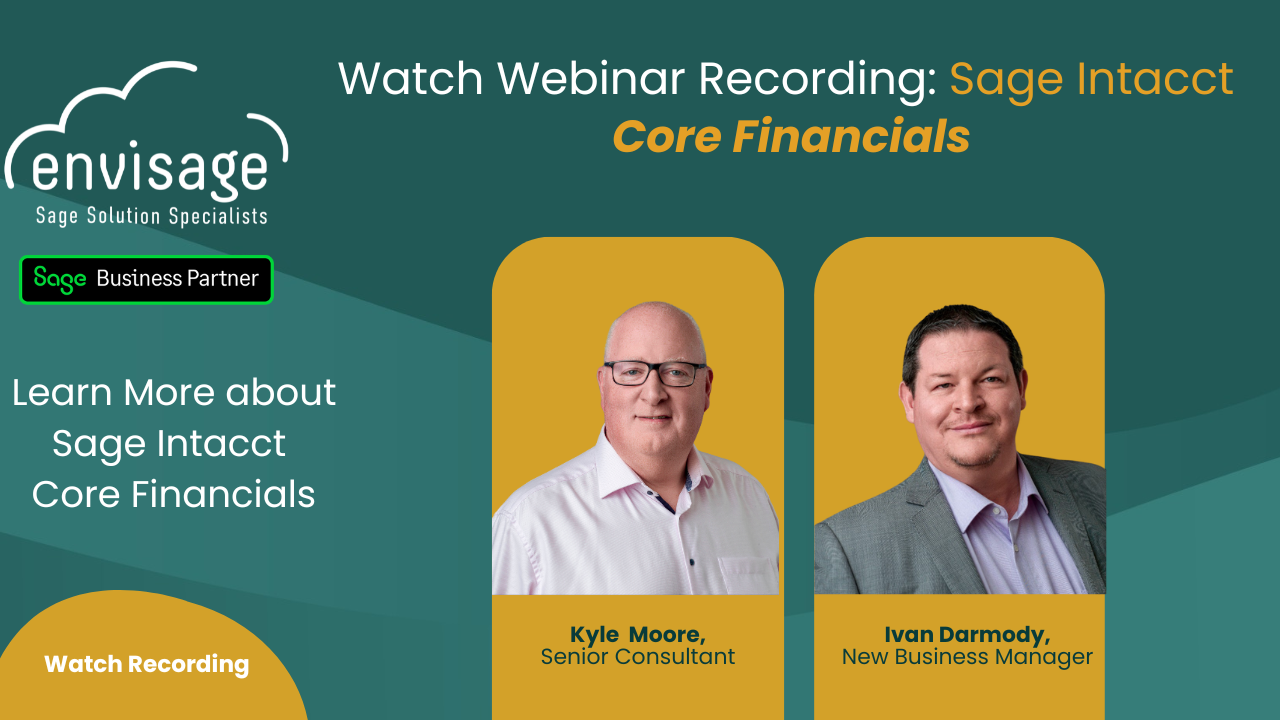
Webinar Series: Deep Dive into Core Financials  

To further educate businesses on how to harness the power of Sage Intacct Core Financials, we are excited to announce the webinar recording on the Sage Intacct Webinar Series. The webinar provides a deep dive into Core Financials, offering valuable insights into how Sage Intacct can transform your financial management. 

You can discover: 

• Automation of Key Financial Processes: Learn how to reduce manual intervention and improve efficiency through automation. 

• Simplification of Multi-Entity Consolidations: Understand how to achieve better accuracy and efficiency in consolidating financial data across entities. 

• Real-Time Insights for Smarter Decision-Making: Discover how to leverage real-time data for informed decision-making, enhancing your strategic initiatives. 

• Streamlined Operations with Data-Driven Strategies: Gain insights into how data-driven approaches can optimise your financial operations and lead to better outcomes. 

• Leveraging AI for Automatic Data Validation: Explore how artificial intelligence can enhance the accuracy of your data and reduce the risk of errors in financial reporting. 

Watch here: https://bit.ly/4dLWYbB  

About the Author

Picture of Ivan Darmody

Ivan Darmody

Ivan is a customer-centric self-starter with a passion for technology. With extensive sales experience in various industries, he has focused on problem-solving customers’ requirements and providing the best solutions to streamline their processes while maximising potential utilising both direct and indirect sales channels.